
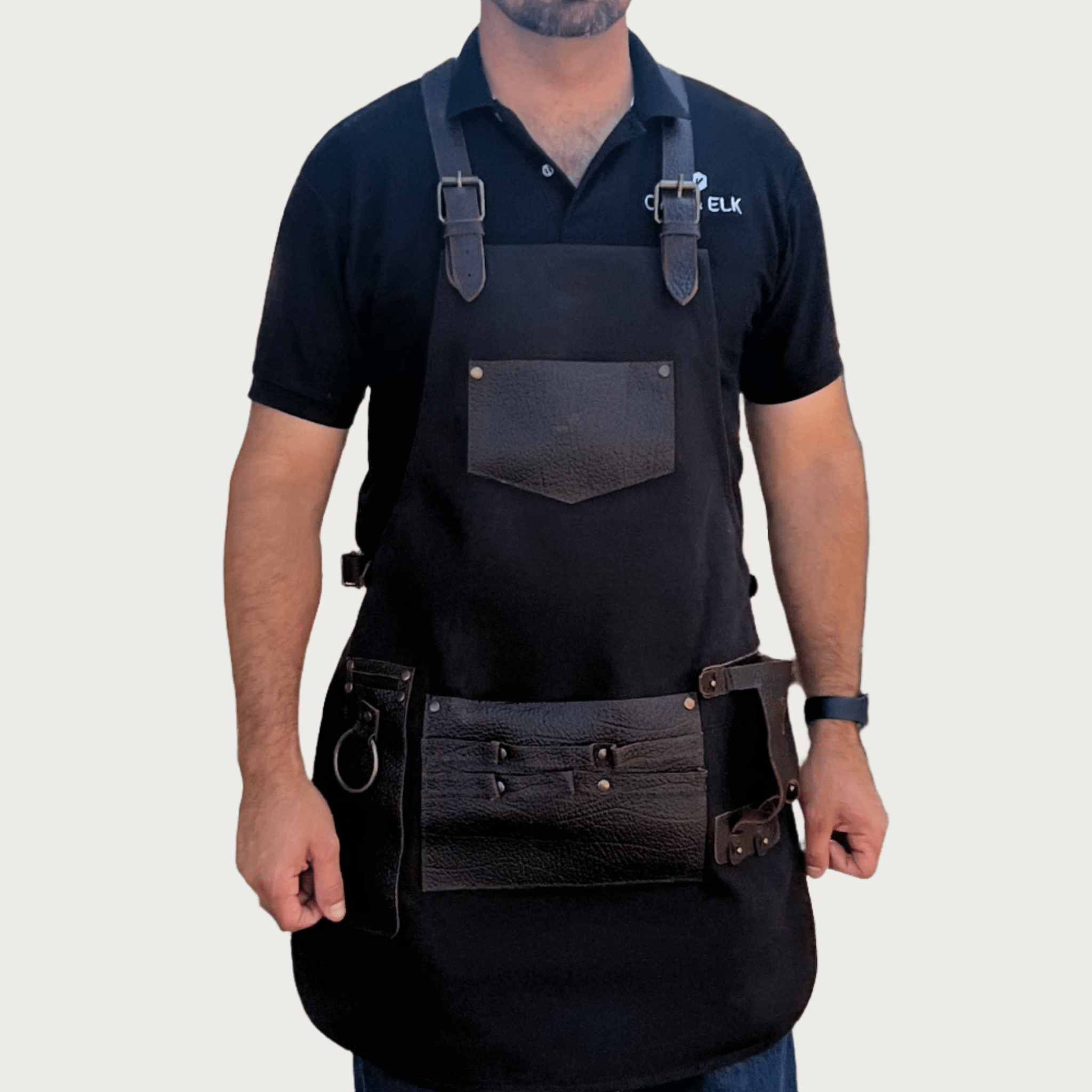
Leather Apron for Blacksmithing: Heat, Sparks & Fit
Choosing a leather apron for blacksmithing is less about looks than about three unglamorous decisions: how much hide sits between you and the scale, how far the bib and skirt actually reach, and how the straps carry weight over a long session at the anvil. Get those right and the apron disappears while you work. Get them wrong and you will take it off within an hour.
This guide covers what leather genuinely protects against at the forge, where its limits are, and how to read the specs that matter before you buy.
What a leather apron protects against at the forge
Blacksmithing throws off a specific mix of hazards, and leather handles some of them better than any woven fabric.
- Scale and hot fragments. Flaking oxide comes off hot stock at every hammer blow. Leather resists momentary contact and lets fragments fall away rather than embed or melt into the surface.
- Sparks from grinding and wire brushing. Angle grinders throw far more sparks than the forge itself. Leather does not readily catch or melt the way polyester and nylon do.
- Radiant heat while you work close. Standing beside an open forge for hours is a slow, dry heat load. A hide barrier over the torso takes the edge off.
- Abrasion and snags. Leaning into a post vise, dragging stock across the bench and handling rough bar stock all wear cloth through quickly.
The everyday case for hide over cotton is the same one that applies to a leather apron in a woodworking shop: it wears in rather than out, and it shrugs off the kind of contact that shortens the life of a canvas apron.
What it does not do, and where to be honest
A leather apron is protective clothing, not certified personal protective equipment. It is worth being blunt about this, because plenty of marketing is not.
- It is not rated flame-resistant workwear unless a manufacturer states a specific standard and test. Assume no rating unless one is documented.
- It is not a welding apron. Sustained arc welding spatter, heavy slag and prolonged UV exposure call for a purpose-built split-leather welding apron and sleeves, typically far heavier hide than a general shop apron.
- It does not replace eye protection, hearing protection or gloves. A face shield or safety glasses come first, every time.
- It will scar. Pitting, scorch marks and darkened patches are what a working apron looks like after a year. That is the material behaving correctly, not failing.
For hobby and light-to-moderate forge work — drawing out, punching, scrolling, finishing at the grinder — a well-cut general leather apron is the right tool. For production forge welding or arc work, buy dedicated gear and keep the leather apron for everything else.
Leather weight: how ounces translate to protection
Leather thickness is measured in ounces, where one ounce corresponds to roughly 1/64 of an inch. A 4 oz hide is about 1.6 mm; 8 oz is about 3.2 mm. More thickness means more thermal mass and more resistance to a hot fragment, but also more weight on your shoulders and less freedom to bend.
| Approximate weight | Thickness | Best suited to |
|---|---|---|
| 3–5 oz | 1.2–2.0 mm | Light shop work, grinding, finishing, all-day comfort |
| 5–7 oz | 2.0–2.8 mm | General forge and bench work; the common middle ground |
| 8 oz and up | 3.2 mm+ | Heavy forge and welding-specific aprons; stiff and heavy |
Grain matters alongside weight. Pebbled and full-grain hides hide marks well and stay supple; suede-finish split leather is what most dedicated welding aprons use because it is thick and cheap to produce, though it holds soot and stiffens with heat. If the difference between grain types is new to you, our comparison of leather versus canvas aprons breaks down how each material ages under real use.
Coverage: where the apron needs to reach
Most complaints about shop aprons come down to cut, not material. Measure before you order.
- Bib width. The bib should clear your chest to the outside of each pectoral. A narrow bib leaves the sides of your torso exposed every time you turn to the forge.
- Bib height. Aim for coverage from just below the collarbone. Higher than that and the neckline chafes; lower and sparks find your sternum.
- Length. Mid-thigh is the practical minimum for standing anvil work. Knee length is better if you sit to file or work at a low vise.
- Skirt width. The lower panel should wrap toward your hips rather than hang as a narrow strip, so that turning at the waist does not expose your thighs.
To size yourself, measure from the point where the neck strap will sit down to where you want the hem, then measure chest width at the widest point. Compare both against the product listing rather than relying on small, medium and large labels, which vary wildly between makers.
Straps: cross-back versus neck strap at the anvil
Hammer work is repetitive shoulder work, and the strap system decides whether your neck carries the load.
- Neck strap. Simpler, faster to put on, easier to share between people. All the weight hangs on the cervical spine, which becomes noticeable with a heavier hide over a long session.
- Cross-back. Distributes weight across both shoulders and keeps the neck free. It takes a moment longer to get into and needs adjusting once to your frame, after which it stays set.
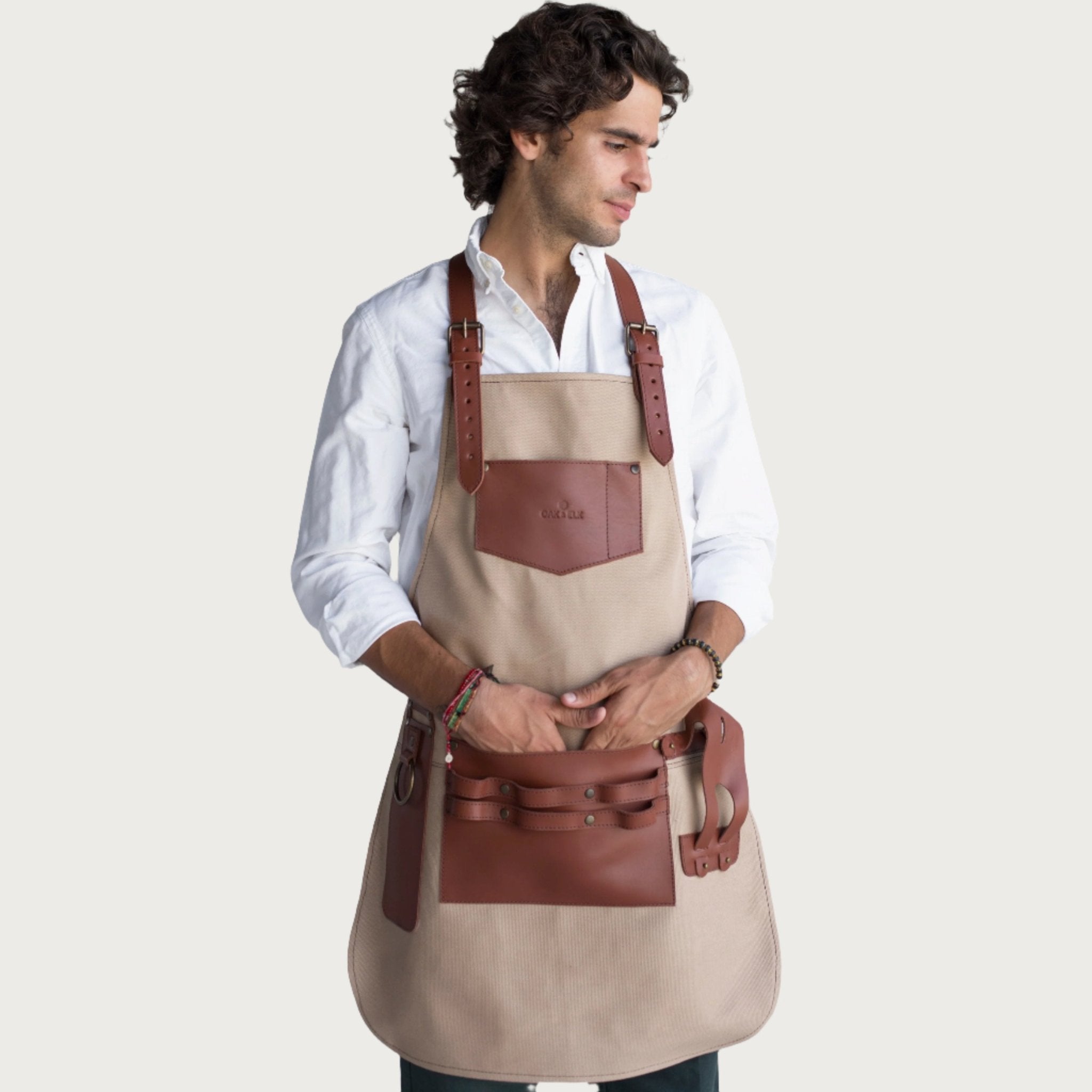
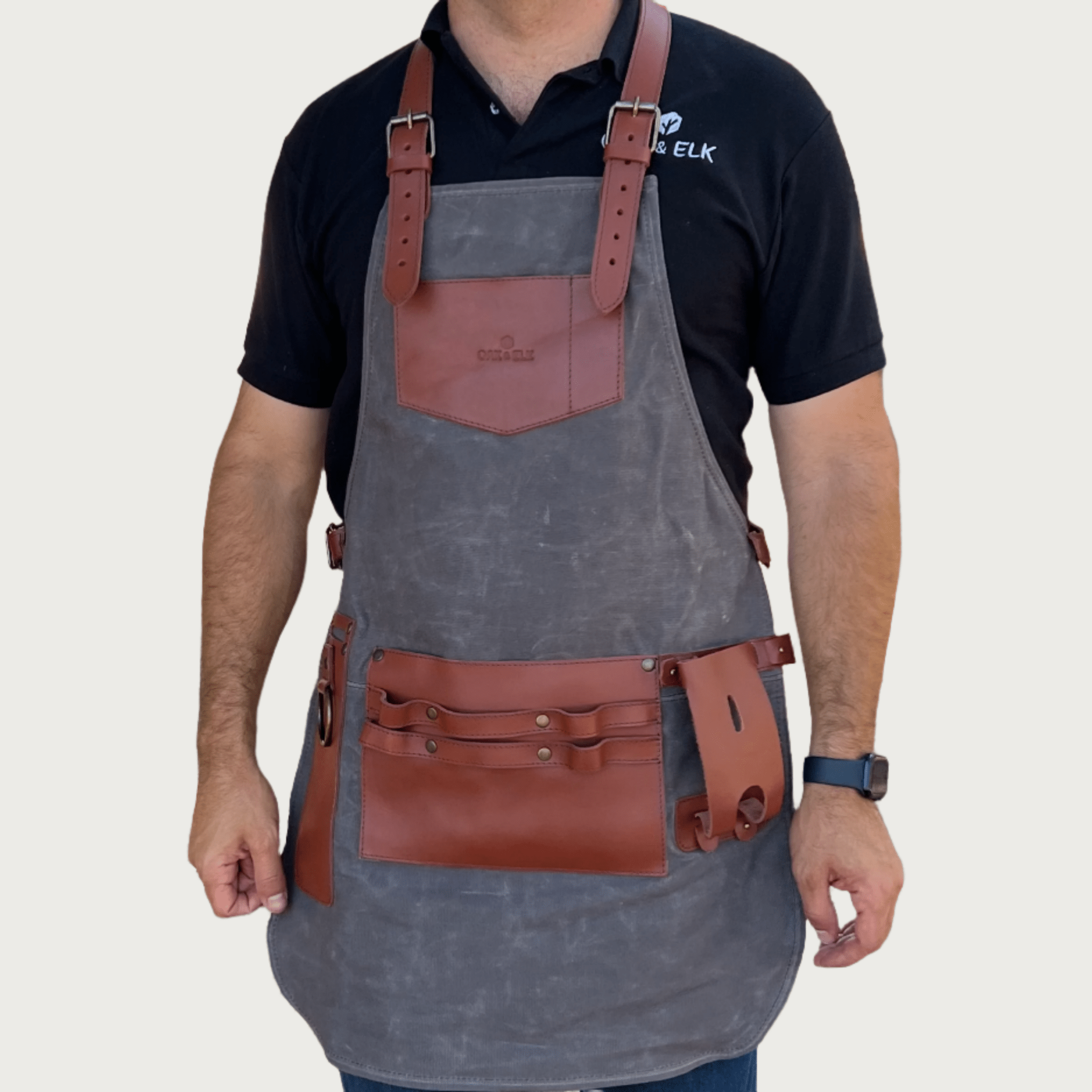
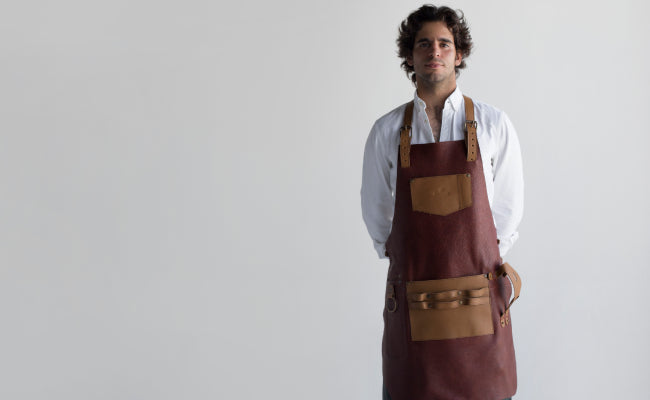
Whichever style you choose, adjustability is the feature that matters. Straps you can genuinely tune — rather than fixed loops — let you set the bib height precisely so the apron sits where the sparks land. The Max Leather Apron uses pebbled leather with adjustable straps and multiple tool pockets, and comes in Pebbled Nutmeg, Coldbrew and Black at $280. If you want a lighter apron for grinding, filing and finish work, the Vic Canvas & Leather Apron pairs a canvas body with leather panels at $250, in Beige, Black, Blue, Gray and Olive.
Pockets that survive a shop
Blacksmiths carry fewer small items than woodworkers, but the ones they carry are heavy: a punch, a center punch, a rule, a marker, occasionally a pair of tongs hooked over the top. Look for reinforced pocket mouths, because that seam is the first thing to fail under a steel tool dropped in from height. Avoid deep, narrow pockets low on the skirt — anything in them jabs your thigh the moment you crouch.
A word on habit: empty the pockets before you set the apron down near the forge. Hot scale collects in an open pocket and can smolder against the lining unnoticed.
What to wear underneath
The apron is one layer of a system. Natural fibers belong under it — cotton or wool, long sleeves, no synthetics against the skin, because polyester and nylon melt rather than char. Cuff your sleeves rather than rolling them into a pocket that catches scale. Closed leather boots with the trouser leg over the top, never tucked in, keep fragments from landing inside.
Care after a forge session
A working apron needs less fuss than most people assume, and over-conditioning does more harm than neglect.
- Brush off scale and soot dry, with a stiff brush, before anything else.
- Wipe grease with a barely damp cloth. Let the apron air dry away from the forge and away from direct sun.
- Never dry leather with heat. Forced drying draws out oils and leaves the fibers brittle.
- Condition sparingly, once or twice a year, only when the surface feels dry to the touch.
- Hang it flat rather than folding it, so creases do not set into permanent cracks.
Our guide to maintaining leather aprons covers oil stains, mildew and long-term storage in more detail.
Frequently asked questions
How thick should a blacksmith apron be?
For general forge work, roughly 5 to 7 oz leather (about 2 to 2.8 mm) balances protection against comfort. Heavier hide, 8 oz and above, is normally reserved for welding-specific aprons where mobility matters less than shielding.
Can I use a leather apron for welding?
Only for occasional, light tacking, and even then a purpose-built welding apron is the safer choice. Sustained arc welding produces spatter and slag that call for heavy split-leather gear rated for the task, along with sleeves, gloves and a proper helmet.
Will sparks ruin a leather apron?
Individual sparks usually leave small dark marks rather than holes. Over time these accumulate into the mottled patina typical of a shop apron. Sustained contact with a hot workpiece will scorch the surface, so move the stock rather than resting it against yourself.
Is leather or canvas better for blacksmithing?
Leather for anything near heat, scale or sparks. Canvas is cooler and lighter, which suits assembly, layout and finishing work, but it scorches and burns through where leather only marks. Many smiths keep one of each and switch by task.
The short version
A leather apron for blacksmithing earns its place through fit and coverage as much as material. Choose a hide weight you will actually wear all day, insist on a bib and skirt that reach where the sparks go, adjust the straps once and properly, and be clear-eyed about the line between a shop apron and certified welding gear. Beyond that, let it take the marks. An apron that looks new after a year has not been doing its job.