Leather Edge Finishing: Burnished vs Painted vs Turned
Leather edge finishing is the step most buyers never notice and most makers obsess over. Every cut piece of leather has an exposed edge of raw fibres, and how a workshop seals, folds or coats that edge decides how the bag looks on day one and how it holds up in year ten. This guide explains the four main methods, which leathers suit each, and what to check before you buy.
Why the Edge Matters More Than It Looks
Leather is a dense web of collagen fibres. The grain side is tight and smooth, but once a blade cuts through the hide, the cross-section is open and porous. Left alone, that cut edge can fuzz, absorb dirt and moisture, and slowly fray where a strap rubs against a hip or a handle flexes in the hand.
Edges also take more abrasion than any other part of a bag. Corners hit doorframes, strap edges ride against coats, and handle edges meet skin oils every day. That is why careful edge work is one of the clearest signs of construction quality, alongside how a bag is stitched and how thick the leather is.
The Four Main Leather Edge Finishing Methods
Most leather goods use one of these approaches, sometimes combining two on the same piece:
- Burnished edges: the cut edge is sanded and rubbed with friction until the fibres compress and lie flat.
- Painted edges: a flexible coating, often called edge paint or edge coat, is built up in thin layers over the cut edge.
- Turned (folded) edges: the leather is thinned near the edge, folded back on itself and glued or stitched, so no cut edge shows.
- Raw edges: the edge is left as cut, sometimes lightly sanded, for a rugged look.
Burnished Edges
Burnishing is the oldest of the four techniques and is closely tied to saddlery and harness work. The maker first rounds the edge with a beveler, then sands it with progressively finer abrasives. Next comes friction: a wooden slicker, canvas cloth or motorized burnisher is run along the edge with a lubricant such as water, gum tragacanth or beeswax. The heat and pressure compress the fibres into a smooth, slightly glossy surface. Edge dye can be added for colour.
The catch is that burnishing depends on the leather itself. Vegetable-tanned leather, with its firm, tannin-filled fibre structure, takes a burnish beautifully. Chrome-tanned leather is softer and springier, and many experienced makers say it simply will not burnish in the same way; some go further and call it impossible. If you want to understand why the two leathers behave so differently, our guide to vegetable tanned vs chrome tanned leather covers the chemistry.
A good burnished edge is durable and easy to refresh. When it starts to look dry or fuzzy after years of use, a little water or wax and some rubbing usually brings it back.
Painted Edges
Painted edges are standard across much of the luxury handbag world. After the edge is trimmed and sanded, the maker applies a thin layer of edge paint, lets it dry, sands it smooth, and repeats. Several layers create a crisp, uniform line in almost any colour, and it works on leathers that cannot be burnished, including soft chrome-tanned and combination-tanned hides.
The trade-off is longevity at stress points. Edge paint sits on top of the leather rather than being part of it, so over years of flexing it can crack or start to peel, most often on handles and strap edges. Some traditional makers argue this makes painted edges less durable than a well-burnished one. In fairness, a carefully layered edge on a well-designed bag can look sharp for a long time, and when it does wear, a leather repair specialist can strip and repaint it.
Turned (Folded) Edges
A turned edge hides the cut entirely. The leather is skived very thin along the border, folded over and secured with adhesive and stitching. The result is soft, rounded and refined, which is why you see it on small leather goods and dressy bags made from supple leathers that do not take a burnish.
Because the folded leather is so thin, a turned edge can eventually wear through on high-abrasion corners. That is not a defect, just a known limit of the method, and it is worth remembering if a bag will live a hard life.
Raw Edges
Some makers leave edges as cut, especially on thick, firm vegetable-tanned leather where the natural edge has its own appeal. Raw edges can look honest and workmanlike, but they collect dirt and can fuzz over time. Many raw-edged pieces benefit from a quick burnish later on.
Leather Edge Finishing Methods Compared
| Method | Best-suited leathers | Look | Typical wear pattern | Maintenance |
|---|---|---|---|---|
| Burnished | Firm vegetable-tanned leather | Smooth, satin to glossy, natural or dyed | Can dry out or fuzz slightly over years | Re-burnish with water or wax |
| Painted | Most leathers, including chrome-tanned and soft hides | Crisp, uniform, any colour | Can crack or peel at flex points | Strip and repaint, often by a specialist |
| Turned | Soft, supple leathers | Rounded, refined, no visible cut | Thin fold can wear through on corners | Repair usually means replacing the panel or binding |
| Raw | Thick vegetable-tanned leather | Rugged, natural | Absorbs dirt, may fuzz | Can be burnished at any time |
How to Check Leather Edge Finishing Before You Buy
You do not need a workshop to judge leather edge finishing. A quick look and a light touch tell you a lot:
- Run a fingertip along a strap edge. A burnished edge feels smooth and firm. A painted edge feels slightly rubbery and even. Roughness or loose fibres suggest the edge was skipped.
- Look at corners and curves. Even finishing around tight curves takes time and skill. Blobs, gaps or wavy lines show rushed work.
- Check where layers meet. On straps made of two layers glued together, the seam between them should be nearly invisible after finishing.
- Flex a handle gently. Paint should bend with the leather without crazing or lifting at the edge.
- Match the method to the leather. Firm vegetable-tanned leather and a painted edge is a valid choice; soft leather with a burnished edge is a claim worth questioning.
Leather Edge Finishing in Real Bags
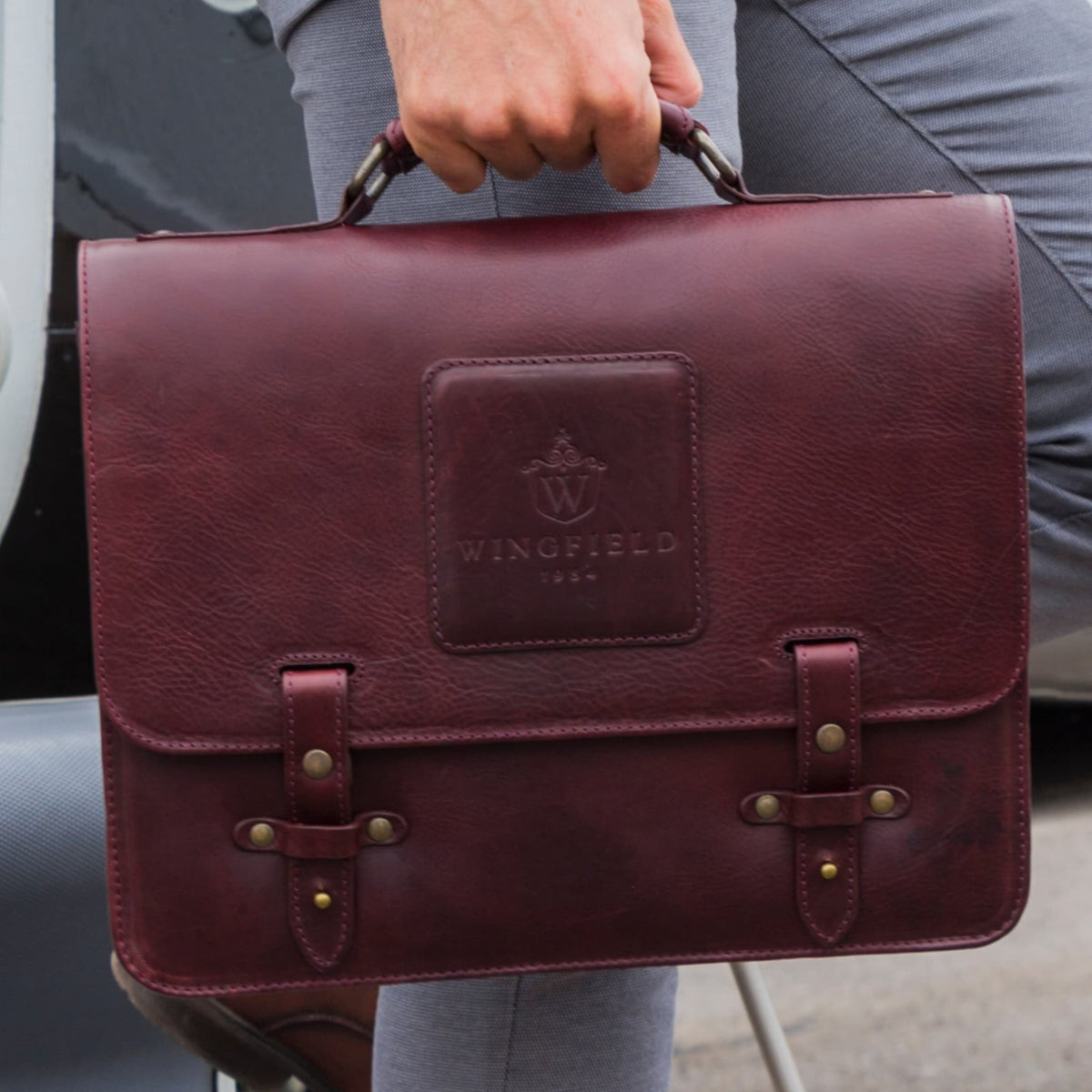
Edges are easiest to read on the parts that work hardest: straps, handles and flap borders. On a structured piece like the Wingfield Leather Messenger Bag, cut from vegetable-tanned leather with old brass hardware and an adjustable strap, look at the flap and strap edges and notice how they age alongside the leather's patina. The Classic Leather Tote pairs Signature, Pebbled or Rustic leather bodies with vegetable-tanned leather handles, the part of a tote your hands touch most.
Travel bags put edges under the most strain. The Dakota Medium Leather Duffel Bag combines full-grain cowhide with reinforced stitching and a detachable leather shoulder strap, so its strap edges are a good place to watch how finishing and stitching work together over many trips. Even workwear shows it: the straps and pocket borders of the full-grain pebbled Max Leather Apron take daily bending and rubbing in a shop or at the grill.
Caring for Leather Edges Over Time
Whatever the method, good leather edge finishing still benefits from a little attention. Edge care is simple and mostly preventive:
- Keep conditioner off painted edges when you treat the leather; some products can soften edge paint.
- Wipe burnished edges with a barely damp cloth if they get dirty, then let them dry naturally.
- Refresh a dry burnished edge with a little beeswax and a soft cloth.
- Address cracked edge paint early. Small splits let moisture into the fibres underneath, and a repair is easier before the edge frays.
When an edge does need more than home care, it is one of the most fixable parts of a bag. Our guide on how to repair a leather bag explains when to do it yourself and when to see a professional.
Frequently Asked Questions
Which is better, burnished or painted leather edges?
Neither is better in every case. Burnished edges suit firm vegetable-tanned leather and are easy to refresh at home. Painted edges work on almost any leather and give a crisp, coloured finish, but may need professional repainting after years of heavy flexing.
Can chrome-tanned leather be burnished?
Not in the traditional sense. Chrome-tanned leather is soft and springy, so its fibres do not compress into a smooth burnish the way vegetable-tanned fibres do. Makers usually paint, coat or turn the edges of chrome-tanned leather instead.
Is peeling edge paint a sign of a bad bag?
Not necessarily. Edge paint is a surface coating, and some wear on handles after years of use is normal. Peeling within weeks, or in large flakes, points to rushed application with too few layers.
Can damaged leather edges be repaired?
Yes. Burnished edges can be re-sanded and re-burnished, and painted edges can be stripped and repainted by a leather repair specialist. Turned edges are harder to fix and may need a new binding or panel.