
Article: Is Leather Biodegradable? An Honest End-of-Life Guide
Is Leather Biodegradable? An Honest End-of-Life Guide
Is leather biodegradable? The honest answer is more interesting than either side of the argument usually admits: leather is made from a material that would rot in days, and tanning exists precisely to stop that from happening. Understanding what that means at the end of a bag's life tells you more about a material's real footprint than any label on a swing tag.
What "biodegradable" actually means
Biodegradation is the breakdown of a material by microorganisms into water, carbon dioxide, biomass and mineral salts. The word on its own says nothing about speed or conditions. A material can be biodegradable in an industrial composter at 58 C and effectively inert in a landfill. It can also break down into fragments that are technically smaller but environmentally worse.
So the useful question is never "does this eventually break down." It is: how fast, under what conditions, and what is left behind. Applied to leather, the answers are specific and slightly uncomfortable.
The honest answer: tanning is designed to stop decay
A raw hide is collagen, water and fat. Left alone it putrefies within days. Tanning cross-links the collagen fibres so bacteria and enzymes can no longer take the protein apart. Every tannage on earth, vegetable or mineral, does the same fundamental job: it makes a perishable protein durable.
That is why claims of "fully biodegradable leather" deserve scepticism. Independent testing consistently shows that finished leather resists microbial breakdown, and that the resistance is the point. Vegetable-tanned leather does degrade in soil or compost conditions, but slowly, on the timescale of a buried hardwood branch rather than a banana peel. Chrome-tanned leather, where chromium salts form very stable bonds with collagen, degrades far more slowly still, and results vary enormously with the finish applied on top.
Finishes matter more than most buyers realise. A pigmented, plasticised topcoat over a hide is, chemically, a thin polymer film. A heavily coated "leather" can behave at end of life more like a plastic-faced composite than like a hide.
Vegetable tanned and chrome tanned at end of life
Both tannages are legitimate. They are optimised for different things, and the differences show up when a product is finally discarded.
| Factor | Vegetable tanned | Chrome tanned |
|---|---|---|
| Tanning agent | Plant tannins (quebracho, mimosa, chestnut, oak) | Chromium(III) salts |
| Process time | Weeks to months in pits or drums | Typically a day or less |
| Breakdown in soil or compost | Slow but measurable | Substantially slower; often minimal in normal conditions |
| Residue of concern | Tannins, dye and finish chemistry | Chromium content requiring controlled disposal |
| Typical use | Structured goods, straps, saddlery, patina-forward bags | Soft garment leather, upholstery, footwear linings |
If you want the full process comparison rather than the disposal snapshot, our breakdown of vegetable tanned versus chrome tanned leather covers water use, effluent treatment and why most of the world's leather is still chrome tanned.
What happens to synthetic alternatives instead
The comparison only makes sense against what a shopper would otherwise buy. Most material marketed as "vegan leather" is polyurethane or PVC coated onto a polyester backing cloth. Polyurethane does not meaningfully biodegrade in the environment either, and its failure mode is different from leather's.
Peer-reviewed work on photoaging of polyester-backed polyurethane synthetic leather has documented the release of microplastic particles and associated chemicals as the coating weathers. That is the real end-of-life story for a coated synthetic: it does not disappear, it fragments. Coated fabrics also tend to fail structurally within a few years, as the polymer layer cracks and delaminates from the backing, which is why so many synthetic bags reach the bin far sooner than a hide would.
None of this makes leather blameless. Cattle farming carries a substantial climate and land-use burden, and leather is a co-product of that system rather than a way to escape it. We work through the trade-offs in our comparison of real leather and vegan leather bags, and look at the newer plant and mycelium materials in our guide to bio-based leather alternatives, most of which still rely on a polymer binder to reach usable strength.
Why lifespan matters more than compostability
If neither material composts on any human timescale, the environmental argument shifts to a different axis entirely: how many units get made and thrown away to cover the same years of use.
A well-made full-grain bag that stays in service for fifteen or twenty years displaces every replacement that would otherwise have been bought in that window. Nothing about the material makes that outcome automatic; construction does. Saddle-stitched or lockstitched seams, solid brass rather than plated pot metal, replaceable straps, edges that can be re-burnished and hardware that can be swapped are what let a bag reach its second decade.
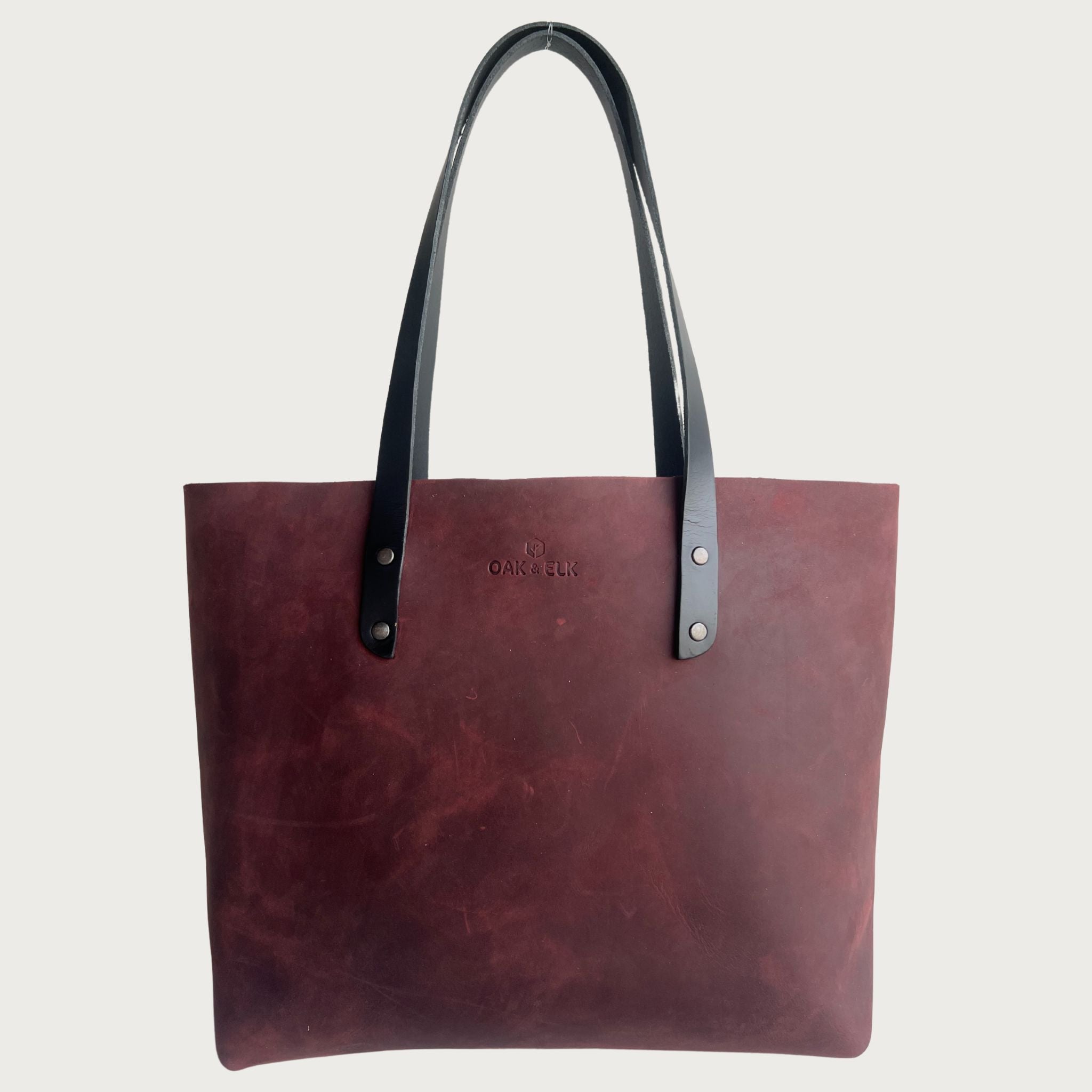
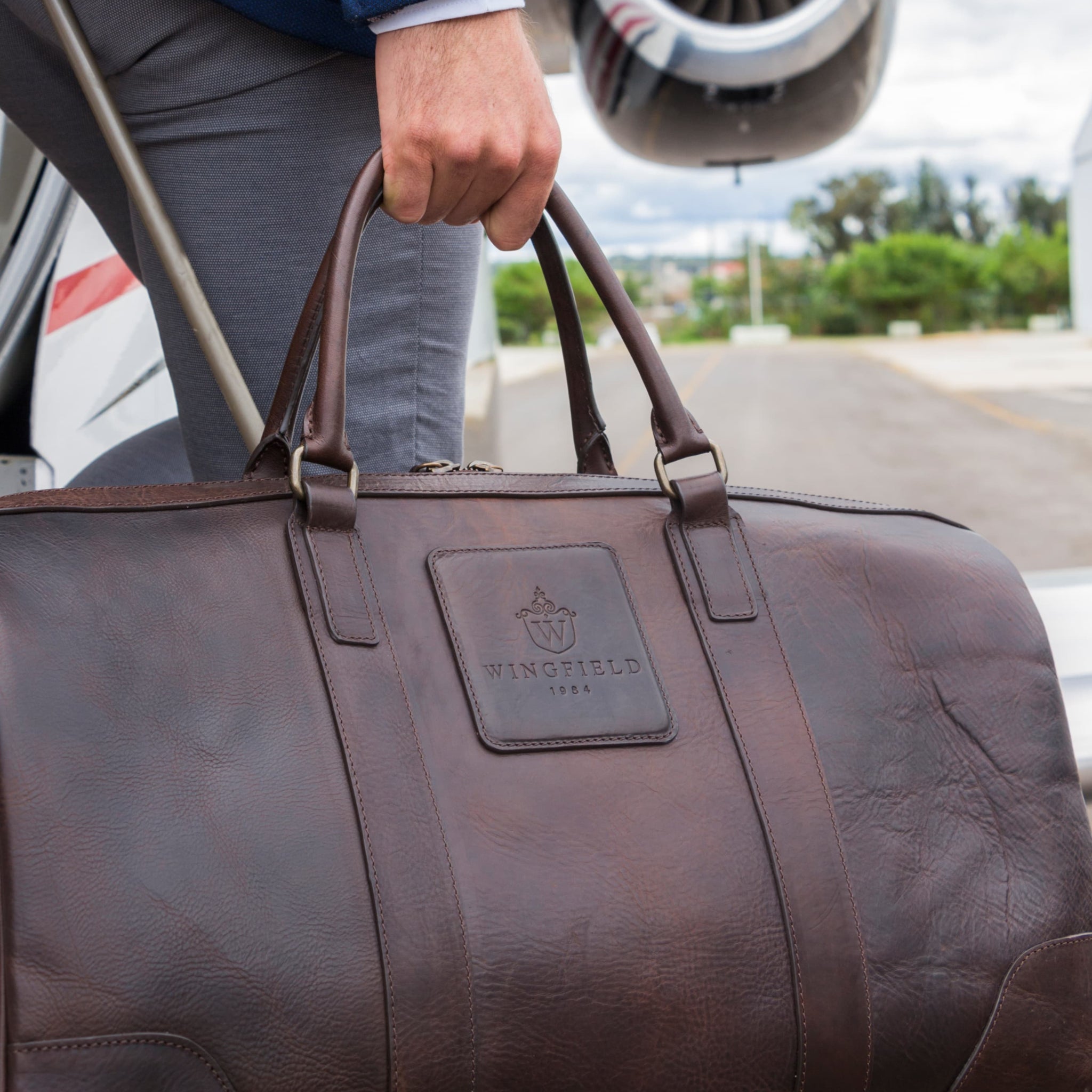
That is the logic behind pieces built to be lived with rather than cycled through. The Classic Leather Tote in premium full-grain leather uses vegetable-tanned handles and old brass-tone hardware, the parts that take the most stress and are most worth repairing. The Wingfield Large Leather Duffel Bag is built from vegetable-tanned leather with premium old brass hardware, a cotton lining and an adjustable leather and textile strap that can be replaced independently of the body. Small goods work the same way: the Ivy Leather Large Wallet is handcrafted from full-grain bovine leather that softens rather than cracks, and the Emma Leather Backpack pairs a full-grain body with a matching adjustable strap and hardware built to be used daily.
Repair, resale and a second life
Leather's real circular advantage is not compostability. It is repairability. Torn stitching can be redone, linings replaced, zips swapped, straps rebuilt, scuffs conditioned back. Very little of that is possible with a coated synthetic, where a cracked polymer face cannot be restored.
- Repair before replacement. A cobbler or leather workshop can usually rebuild a strap or seam for a fraction of the cost of a new bag.
- Recondition rather than discard. Dry, dull leather is nearly always recoverable with cleaning and conditioning, not a reason to buy new.
- Resell or pass it on. A structurally sound leather bag holds resale value in a way that synthetic goods rarely do, keeping it in circulation.
- Keep the hardware. Brass fittings, buckles and D-rings from a bag beyond saving can be harvested and reused by a maker.
Routine care is the unglamorous half of this. Our step-by-step method for cleaning a leather bag at home covers the products and intervals that actually extend service life.
Leather recycling: what exists today
Post-consumer leather recycling is real but still small. Offcuts and end-of-life leather can be shredded into fibre and re-bonded with binders such as hide glue or bio-based adhesives, then pressed into sheet material. Tannery waste streams can also be processed to recover chromium, fats, collagen hydrolysate and biogas.
Be clear about what the output is, though. Shredded and re-bonded material is bonded leather, closer to particleboard than to a hide. It is a legitimate use for waste and a poor choice for a bag you expect to keep. Recycling should be the last stop after repair and resale, not a substitute for them.
How to buy with end of life in mind
- Choose full-grain over corrected or bonded, so the surface can be conditioned and repaired rather than resurfaced.
- Ask which tannage was used, and prefer transparency over vague "eco leather" language.
- Check whether straps, zips and hardware are replaceable before you buy, not after they fail.
- Avoid heavy plastic topcoats; a hide that feels like vinyl behaves like vinyl.
- Treat any claim of a compostable finished bag as a claim requiring evidence.
Frequently asked questions
Is leather biodegradable in a home compost?
Not reliably. Vegetable-tanned leather will break down slowly in soil or compost conditions, over years rather than months, and chrome-tanned leather typically will not break down meaningfully at all. Dyes, finishes and hardware complicate matters further, so a finished bag is not compostable in any practical sense.
How long does leather take to decompose?
There is no single figure, because it depends on tannage, finish, thickness and burial conditions. Untanned hide rots in days. Vegetable-tanned leather degrades over a span better measured in years to decades. Heavily finished or chrome-tanned leather can persist far longer. Anyone quoting a precise universal number is guessing.
Is vegan leather more biodegradable than real leather?
Generally no. Polyurethane and PVC coated fabrics are petroleum-derived plastics that fragment into microplastics rather than mineralising. Some plant-based materials contain genuine biomass, but most still require a polymer binder or coating, which limits their breakdown.
What should I do with a leather bag I no longer want?
In order of preference: repair it, sell or give it away, donate it, or have a maker harvest its leather and hardware. Landfill should be the last option, and it is the one that a repairable, resellable bag rarely reaches.