Full Grain vs Top Grain Leather: A Buyer's Guide
Choosing between full grain vs top grain leather bags is the single decision that most affects how a bag ages, what it costs, and whether it still looks good in ten years. The labels sound almost interchangeable, but they describe two different treatments of the hide with very different outcomes. Here is what separates them, and how to tell which one you are holding.
What grain actually means
A hide has layers. The outermost surface, the one that faced the world, is the grain. It is the densest, tightest part of the hide because that is where the fibers grow closest together. Everything below it, the corium, is looser and softer. How a tannery treats that top surface is what creates the grades you see on a product page.
The grain layer is also where character lives: healed scars, insect bites, wrinkles from the animal's neck, subtle tonal shifts. Manufacturers who want visual uniformity remove it. Makers who want longevity keep it.
Full grain leather: the surface left intact
Full grain leather is the top layer of the hide with nothing sanded, buffed, or coated away. The natural grain pattern stays exactly as it was, marks and all. Because those tightly packed surface fibers are still connected, full grain is the strongest and most water-resistant grade available.
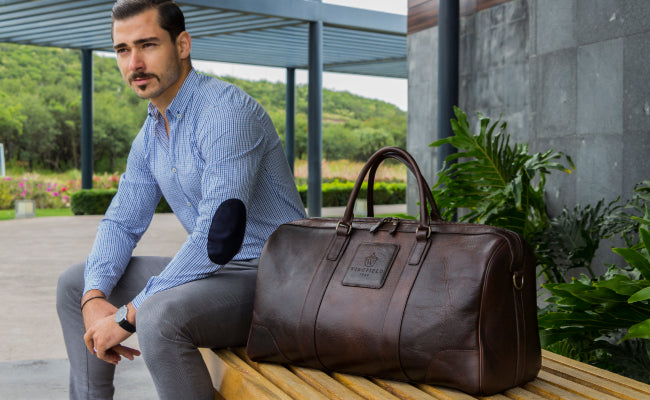
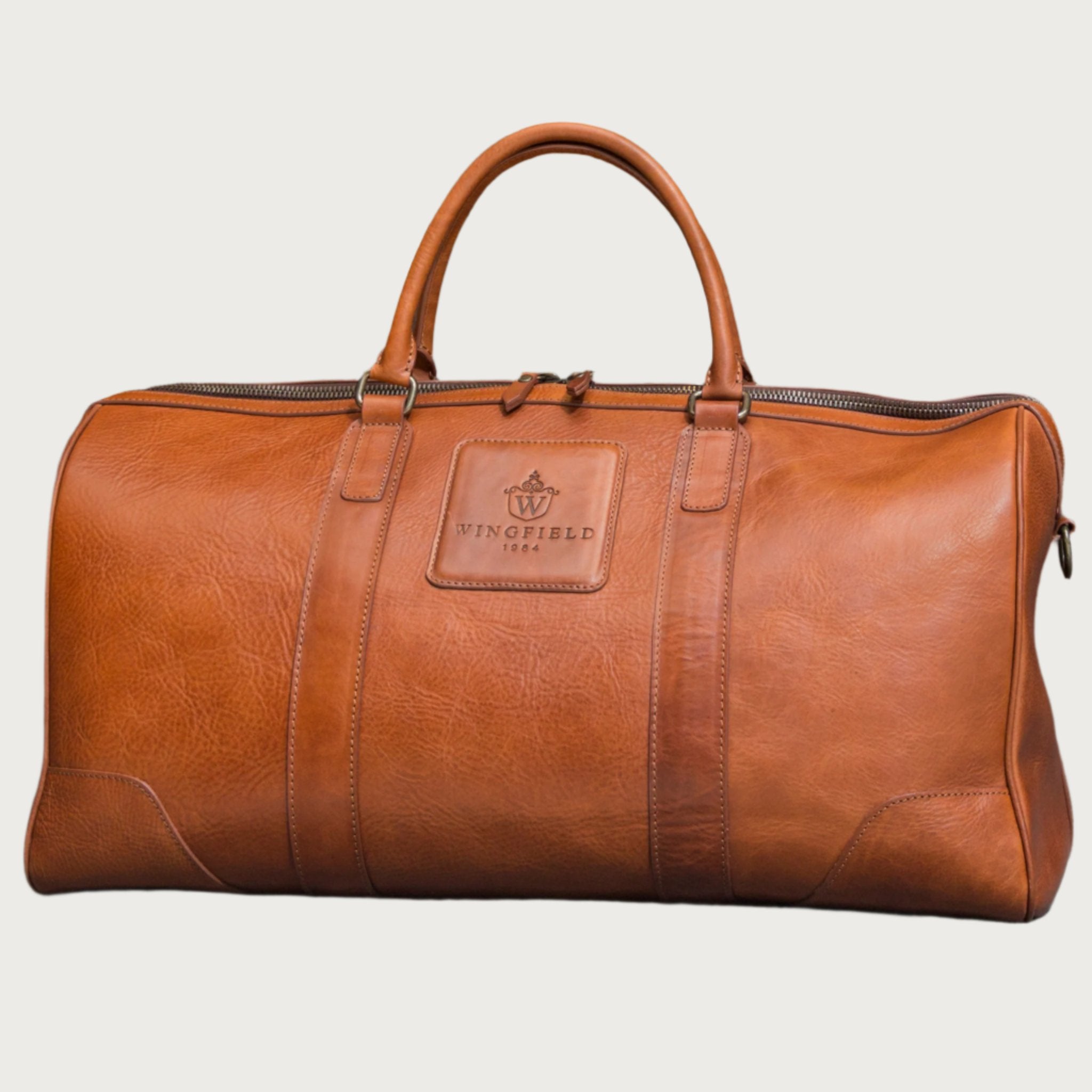
It also breathes. The open fibers absorb the oils from your hands and from conditioning, which is why full grain develops patina: the deepening, slightly glossed finish that makes a well-used bag look better than a new one. Our Wingfield large leather duffel bag is built for that arc. The leather starts firm and matte, then softens into something personal over years of travel.
- Strength: highest of any grade, because the densest fiber layer is untouched.
- Appearance: visible natural markings, no two panels identical.
- Aging: develops patina rather than wearing out.
- Trade-off: heavier, stiffer at first, and more expensive.
Top grain leather: sanded for uniformity
Top grain leather starts from the same outer layer, but the very surface is sanded or buffed to remove blemishes, then usually finished with a pigment or coating. You will also see it sold as corrected grain, which describes the same process more plainly.
The result is a thinner, more pliable, visually consistent material. That has real advantages: it drapes well in structured designs, resists staining because of the finish, and costs less. The cost is longevity. With the strongest fiber layer sanded away and a coating sitting on top, top grain does not absorb oils the same way, so it tends to wear at the surface rather than build patina.
Where genuine leather and bonded leather fit
Two more terms cause most of the confusion at the point of sale. Genuine leather sounds like a guarantee of quality but is, in industry usage, a low grade made from the weaker splits left after the top grain has been separated off. Bonded leather sits lower still: shredded leather scrap mixed with adhesive and pressed onto a backing, closer to particleboard than to timber.
Neither is a scam exactly, but neither belongs in a bag you expect to keep. If a listing says only genuine leather with no further detail, treat that as the ceiling rather than the floor of what you are getting.
Full grain vs top grain leather at a glance
| Attribute | Full grain | Top grain (corrected) | Genuine leather |
|---|---|---|---|
| Layer used | Outer surface, untouched | Outer surface, sanded | Lower splits |
| Surface markings | Natural, visible | Removed or embossed over | Usually heavily finished |
| Develops patina | Yes | Limited | Rarely |
| Lifespan with care | Decades | Several years to a decade | A few years |
| Feel | Firm, softens with use | Smooth and pliable from day one | Uniform, often plasticky |
| Relative price | Highest | Middle | Lowest |
How to tell the grades apart in person
You rarely get a tannery certificate with a handbag, so use your senses instead.
- Look at the edges. Cut leather shows a fibrous cross-section. A perfectly smooth, layered edge with a visible backing fabric usually signals bonded or heavily finished material.
- Check for repetition. If the grain pattern repeats at regular intervals across a panel, it was embossed, not grown.
- Press with a thumbnail. Full grain gives slightly and the mark fades. A hard coating resists and may crease permanently.
- Smell it. Minimally coated leather smells of the tannage. Heavy finishes smell chemical, or of nothing at all.
- Look for imperfections. A small scar or wrinkle is a feature of full grain, not a defect.
Smaller pieces make the test easy because you can handle the whole thing at once. Pick up an Ivy leather large wallet and you can read the edges, the grain and the flex in about ten seconds.
Which grade should you actually buy?
The honest answer depends on what the bag has to do.
- Choose full grain for pieces you will use daily and keep for years: a work tote, a travel duffel, a wallet, a belt. Anything that takes weight, friction, and weather.
- Top grain is reasonable for structured evening bags, light-colored pieces where staining is a concern, or a trend-led shape you do not expect to carry in five years.
- Skip genuine and bonded for anything with straps, handles, or a closure under tension. That is where they fail first.
For everyday carry we build in full grain for exactly this reason. The Emily leather tote and the Emma leather backpack both take real daily load, and the leather responds by getting better looking rather than tired.
Caring for each grade
The two grades want different things. Full grain benefits from conditioning two to four times a year with a light, non-silicone cream: it feeds fibers that are still open and keeps the leather supple. Top grain mostly needs its finish kept clean, since conditioner cannot penetrate a sealed surface anyway. Both should dry naturally away from direct heat if they get wet, and both last longer stored upright and lightly stuffed rather than crushed flat.
One habit matters more than any product: use the bag. Leather that sits in a dust bag for a year dries out. Leather in rotation stays fed by handling.
Frequently asked questions
Is full grain leather worth the extra cost?
If you plan to use the bag regularly for more than a few years, yes. Full grain typically outlasts corrected grain by a wide margin and improves in appearance as it ages, which lowers the real cost per year of ownership even though the purchase price is higher.
Is top grain leather real leather?
Yes. Top grain is real leather taken from the same outer layer of the hide as full grain. The difference is that its surface has been sanded and refinished, which makes it thinner, more uniform, and less able to develop patina.
How can I tell if a bag is full grain leather?
Look for natural, non-repeating grain with small scars or wrinkles, a fibrous rather than layered cut edge, and a surface that gives slightly under a thumbnail. A perfectly uniform pattern is usually embossed onto corrected grain.
Does full grain leather scratch easily?
It scratches, but most light scratches are temporary. Because the surface is uncoated, rubbing a mark with a clean finger or a soft cloth redistributes the natural oils and the scratch usually blends into the patina within days.