How to Tell If a Leather Bag Is Well Made: 8 Key Signs
Learning how to tell if a leather bag is well made is mostly a matter of knowing where to look. Construction quality hides in five or six unglamorous details: the density of the stitching, the way edges are finished, what sits behind a strap anchor, and whether the hardware feels like solid metal or plated pot metal. Once you can read those signals, price stops being your only guide.
Start With the Leather, Not the Logo
Full-grain leather keeps the outermost layer of the hide intact, including its natural grain and imperfections. That surface is the densest, most fibre-rich part of the skin, which is why it resists abrasion and develops patina instead of flaking. Corrected-grain and bonded materials are sanded, embossed or reconstituted, and they wear out rather than wearing in.
- Look at the surface up close. Real full-grain shows pores, healed scars and slight tonal variation. A perfectly uniform, plastic-regular pebble pattern usually means an embossed finish over corrected leather.
- Check a cut edge. Genuine leather shows a fibrous cross-section. A crisp, uniform layer sandwiched between coatings points to a coated split or bonded material.
- Smell it. Vegetable-tanned leather has a warm, woody scent. A sharp chemical or vinyl smell is a warning sign.
- Press the surface. Quality leather creases softly and recovers. Stiff, papery leather that holds a hard fold has usually been heavily finished.
Read the Stitching
Stitching is the single most revealing detail on any bag, because it cannot be faked with a coating. Two things matter: how it was sewn, and how densely.
A hand saddle stitch uses two needles and two threads that pass through the same hole from opposite sides. Each stitch locks independently, so if one thread is cut the seam holds. A machine lock stitch runs a single continuous thread that can unravel from one point of failure. Saddle stitching sits slightly proud of the leather and shows a subtle diagonal thread angle; machine stitching lies flatter and perfectly parallel.
Density is measured in stitches per inch. Around 8 to 11 SPI is the working baseline for a durable everyday bag. Fewer stitches mean longer, more exposed thread spans that snag and abrade. What you want to see across the whole bag is consistency: even length, even tension, straight lines, no skipped holes, no loose tails.
Machine Stitch vs Hand Saddle Stitch
| Detail | Machine lock stitch | Hand saddle stitch |
|---|---|---|
| Thread structure | One continuous thread, interlocked | Two threads, each stitch independent |
| Failure behaviour | Can unravel from a single break | Stays locked; damage stays local |
| Appearance | Flat, uniform, perfectly parallel | Slightly raised, subtle diagonal angle |
| Production time | Fast | Slow, done by hand |
| Typically used for | Main body seams, linings | Straps, handle anchors, high-stress joins |
Neither method is automatically better everywhere. A well-built bag often uses tight machine seams on long panels and reserves hand stitching for the points that carry load.
Inspect the Stress Points
Bags almost never fail in the middle of a panel. They fail where a strap meets the body, where a handle roots into the top edge, and where a D-ring loop is anchored. On a well-made bag, those junctions get reinforcement you can see and feel: a doubled or tripled leather layer behind the attachment, rivets set through the full thickness, and denser stitching than the surrounding seams, often finished with a bar tack or a stitched box-and-cross.
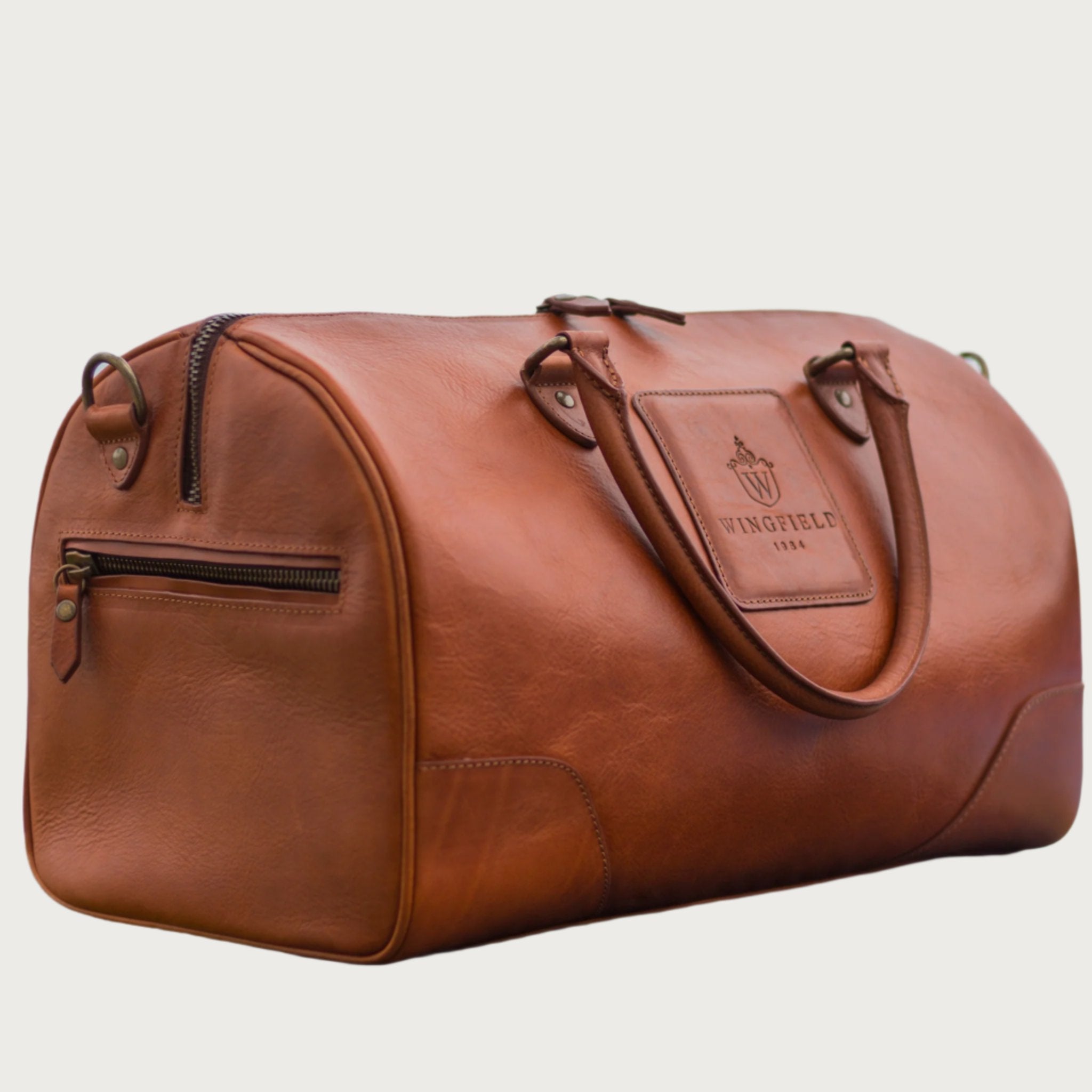
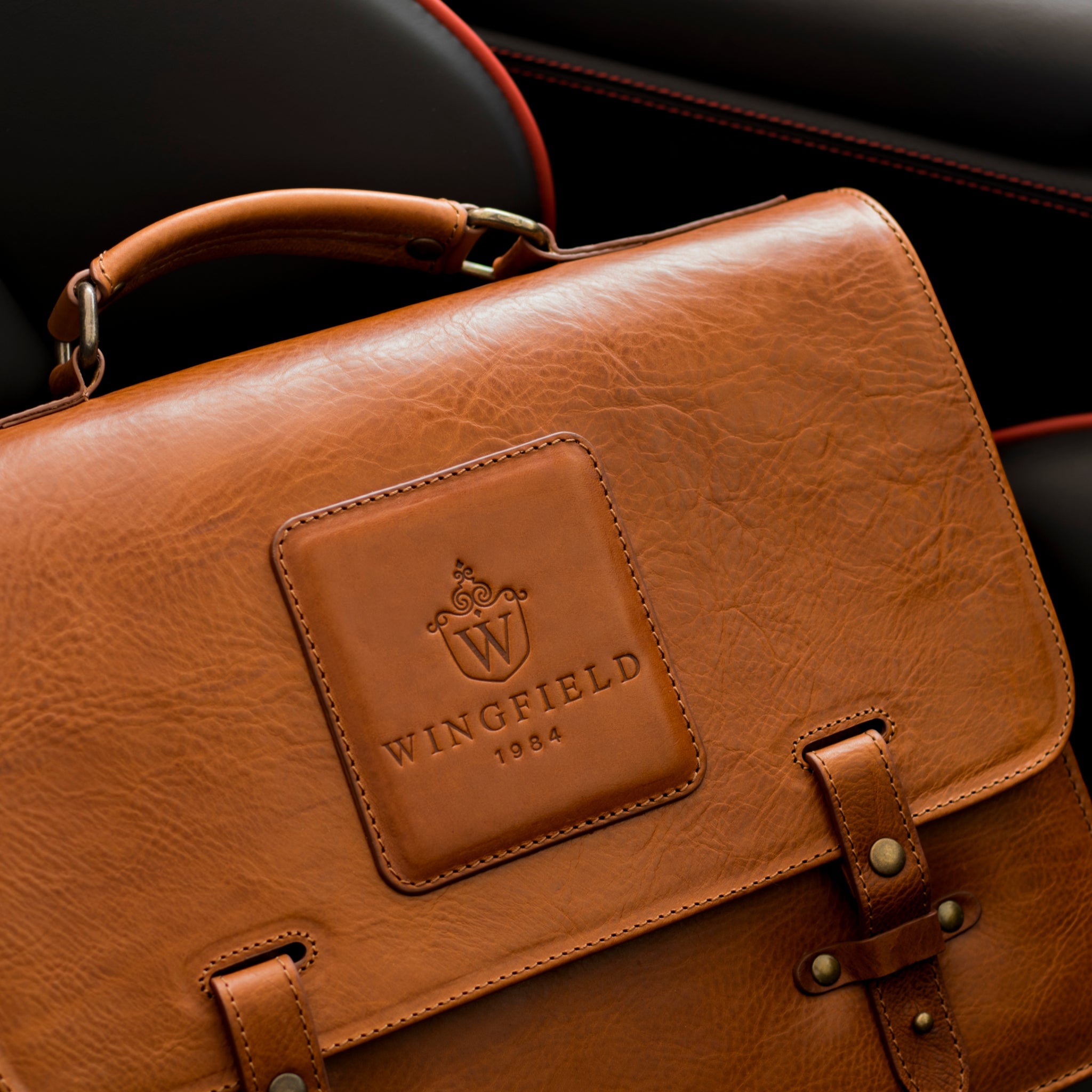
Pick the bag up empty and pull firmly on each handle. There should be no creaking give, no visible stretch at the anchor, and no puckering of the leather around the stitch line. The Wingfield leather messenger bag is a useful reference point here: vegetable-tanned leather, reinforced strap anchors and solid old-brass hardware at every load-bearing junction.
Judge the Hardware Honestly
Hardware is where cost-cutting is easiest to hide and quickest to show. Solid brass and stainless steel resist corrosion and carry weight; zinc alloy plated to look like brass chips at the edges within a season and eventually snaps under load.
- Weight. Solid brass feels dense and cool for its size. Light, hollow-feeling clasps are usually plated alloy.
- Zippers. The pull should glide in one continuous motion, without catching where the tape curves. Branded teeth (YKK and similar) are a reasonable proxy for tested quality.
- Edges and joins. Look at the underside of buckles and D-rings. Rough casting seams, visible mould lines or a differently coloured metal showing through are all signs of plating over cheap alloy.
- Movement. Buckles, twist locks and swivel snaps should move with resistance and no rattle.
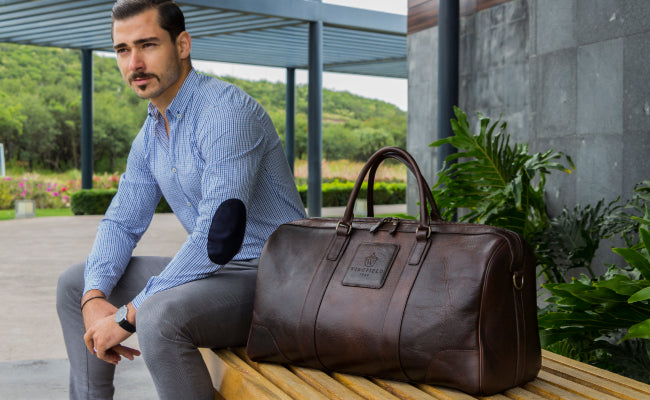
Brass darkens over time. That is oxidation, not failure, and on a bag like the Wingfield large leather duffel it ages alongside the leather rather than against it.
Check the Edges and the Interior
Edge finishing is slow work, so it is one of the first things a factory drops. There are two acceptable approaches. Burnished edges are sanded, sealed and polished smooth so the raw fibre is compressed into a hard, rounded finish. Painted edges are built up in thin layers of flexible edge coat, sanded between coats. Either can last for years. What should worry you is a thick, glossy bead of paint applied in a single pass, or a raw edge left fuzzy and untreated on a bag sold as premium.
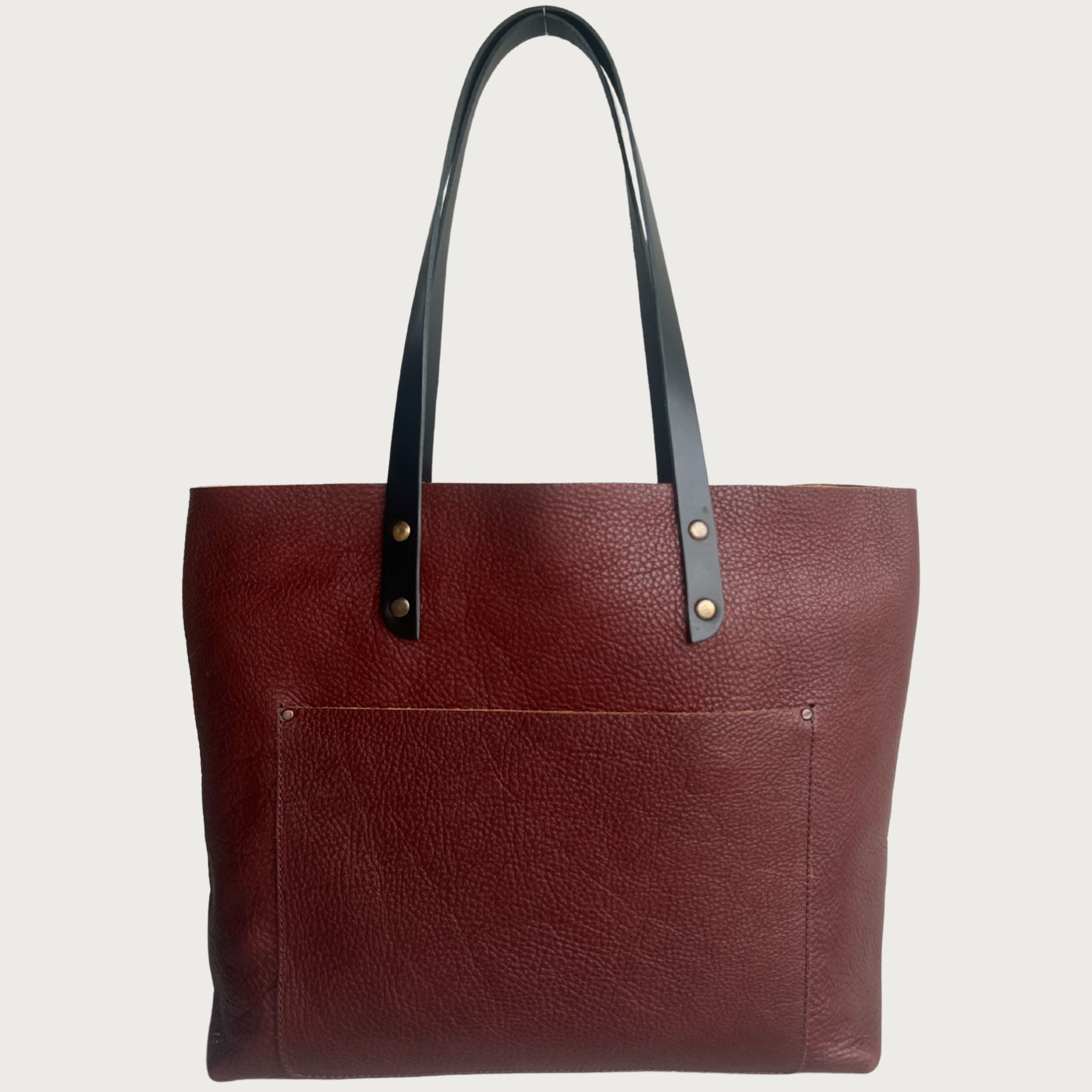
Then open it. Linings tell you what the maker thinks you will notice. Cotton canvas, twill and suede all wear well; thin polyester bonded to a foam backing will pill and delaminate. Look for finished internal seams rather than raw overlocked edges, pockets that are stitched into the structure rather than tacked on, and a base that holds its shape when the bag is empty. A structured tote such as the Classic Leather Tote in full-grain leather should stand on its own without slumping.
Symmetry, Panels and Grain Direction
Cutting is invisible to most buyers and expensive to do well. A careful maker positions each panel so the grain runs consistently, matches colour and texture between the two sides of a bag, and cuts straps from the firm, dense part of the hide along the backbone. A rushed one nests panels to save material, so you end up with a front and back that age at different rates.
Set the bag down and look at it straight on. Handles should be the same length, pockets level, hardware square to the seam lines, and the flap should fall closed in the same position each time. Small asymmetries in a handmade piece are normal; a twisted strap or a lid that will not sit flat is not.
A Practical Checklist Before You Buy
- Examine the leather surface and any exposed cut edge for fibrous, natural structure.
- Count roughly 8 to 11 stitches per inch and confirm they are even and straight throughout.
- Pull firmly on handles and straps; look for reinforcement and rivets at the anchors.
- Weigh the hardware in your hand and run every zipper end to end.
- Run a finger along the edges: smooth and sealed, not raw or thickly painted.
- Open the bag and check the lining, internal seams and pocket attachment.
- Step back and check symmetry, grain consistency and how the bag sits empty.
- Ask what the leather is, where it was tanned, and whether repairs are possible.
The last question matters more than it seems. A maker who can rehandle, restitch or replace hardware on a bag has built it to be taken apart and put back together, which is itself a sign of construction quality. Compact designs benefit from the same scrutiny, and the Paris leather shoulder bag shows what full-grain leather and clean edge work look like at a smaller scale.
Frequently Asked Questions
How can you tell if a leather bag is real leather?
Look at a cut edge for a fibrous cross-section, check the surface for irregular pores and healed marks, and smell the material for a warm, woody scent rather than a chemical one. Real leather also creases softly and recovers when pressed, while coated synthetics hold a hard fold.
Is a hand-stitched leather bag always better than a machine-stitched one?
Not always. Hand saddle stitching is stronger at high-stress points because each stitch locks independently, but a tight, well-tensioned machine seam is perfectly durable on long body panels. The best-built bags combine both, using hand stitching where the load is.
What hardware should a quality leather bag have?
Solid brass or stainless steel, not plated zinc alloy. Solid hardware feels dense for its size, has clean casting with no visible mould lines, and moves with quiet resistance. Zippers should run smoothly around curves without catching.
Does a higher price guarantee a well-made leather bag?
No. Price often reflects brand positioning rather than construction. A bag with full-grain leather, dense even stitching, reinforced anchors, sealed edges and solid hardware is well made regardless of the label on it, and those details are all visible before you pay.
Construction is not a mystery reserved for specialists. Spend two minutes with a bag, in that order, and you will know more about how long it will last than any product description can tell you.