How to Choose the Right Leather Bag Size: Fit Guide
Knowing how to choose the right leather bag size is the difference between a bag you reach for every morning and one that sits in the closet. Most people buy by silhouette and color first, then discover the proportions are wrong for their body, their commute, or the things they actually carry. This guide works the other way around: start with what goes inside, then let dimensions, strap drop, and frame decide the rest.
Start With an Inventory, Not a Silhouette
Empty your current bag onto a table. What comes out is your real brief, and it is usually shorter than people expect: phone, wallet, keys, sunglasses, a lip balm, maybe a water bottle or a paperback. Photograph the pile. That single image is the most useful reference you can bring to a size decision.
Then separate the pile into three groups:
- Always — leaves the house with you every single day.
- Often — a laptop, a notebook, gym shoes, a child's snack.
- Occasionally — items that only appear on travel days or long errands.
Size the bag for "always" plus "often." Buying for "occasionally" is how people end up with a cavernous tote that swallows a set of keys and hangs heavy on one shoulder.
Leather Bag Sizes, Decoded
Bag size language is inconsistent across brands, so treat labels as a starting point and always read the measurements. As a general frame of reference, these are the bands most makers work within.
| Category | Typical width | What it holds | Best for |
|---|---|---|---|
| Mini / micro | Under 20 cm (8 in) | Phone, cardholder, keys, lipstick | Evenings, events, hands-free errands |
| Small | 20–22 cm (8–9 in) | Phone, slim wallet, sunglasses, compact | Weekends, travel days on foot |
| Medium | 22–30 cm (9–12 in) | Everyday carry with room to spare | The daily default for most people |
| Large | 30–40 cm (12–16 in) | Laptop, folder, water bottle, layers | Office, campus, day trips |
| Weekender / duffel | 40–55 cm (16–22 in) | Two to four days of clothing | Short travel, gym, overnight |
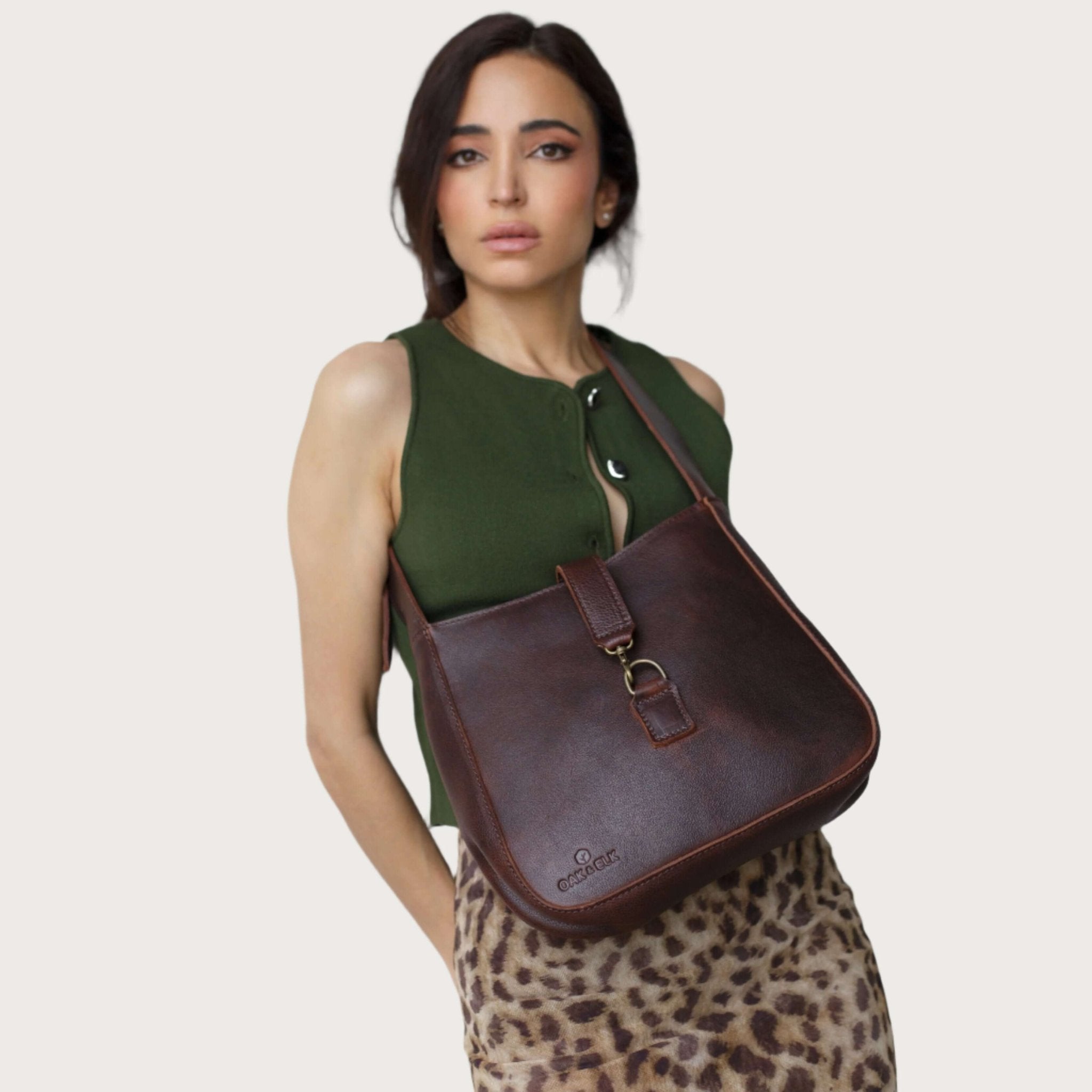
Medium is the sweet spot for a reason. It carries a full day of essentials without the weight penalty of an oversized bag, and it reads as intentional rather than utilitarian. Our Emily Leather Crossbody sits squarely in this band, with an adjustable strap, an interior zip pocket and an open pocket below it — enough structure that small items stay findable.
Match the Bag to Your Frame
Proportion matters as much as capacity. A bag that is roughly in scale with your torso reads balanced; one that is dramatically larger or smaller draws the eye to the mismatch rather than to the piece itself.
- Petite frames tend to be flattered by small and medium bags with a shorter strap drop, which keeps the bag from cutting the body at an awkward point.
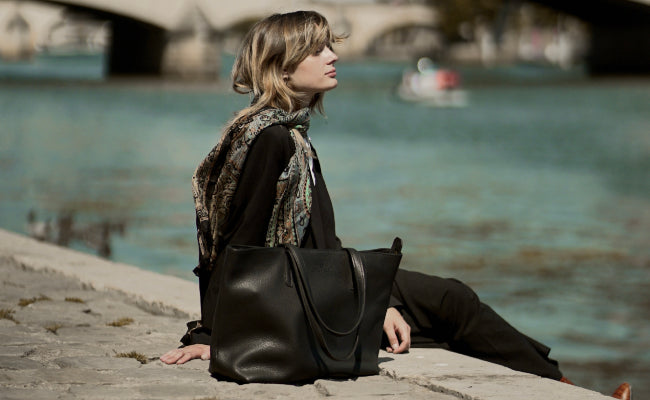
- Tall frames can carry large totes and slouchy shapes without being overwhelmed, and often prefer a longer drop.
- Curvier frames are usually best served by structured shapes that hold their form rather than pressing flat against the body.
A quick check before you commit: hold your arm at your side and note where the bag will land. Anything hitting exactly at the widest part of your hip will visually broaden it. An inch or two above or below reads cleaner.
Strap Drop Is the Measurement People Forget
Strap drop — the vertical distance from the top of the strap to the top of the bag — determines where the bag sits and how it feels after an hour. Two bags with identical dimensions can wear completely differently on the strength of drop alone.
- Roughly 20–25 cm (8–10 in): a handheld or elbow carry. Elegant, but occupies a hand.
- Roughly 25–30 cm (10–12 in): shoulder carry that sits at the ribs. The workhorse range.
- Roughly 55–60 cm (22–24 in): crossbody at the hip. Best weight distribution, best for long days.
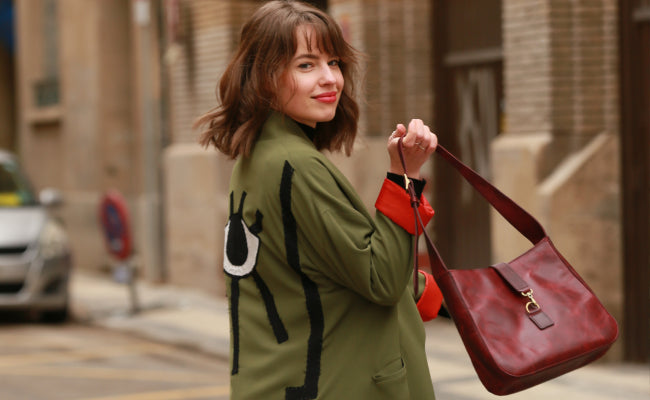
An adjustable strap sidesteps the decision entirely, which is why it is worth prioritizing when you are between sizes. The Paris Leather Shoulder Bag is built on that logic: full-grain leather, a fabric lining that protects what is inside, and an adjustable strap that moves between shoulder and crossbody without compromise.
Sizing for Work and Laptops
Carrying a laptop changes the calculation. Measure the machine, then add roughly 2–3 cm (about an inch) in each direction to allow for a sleeve and for the bag's own structure. A 13-inch laptop needs an interior width of around 33 cm; a 15-inch needs closer to 37 cm.
Weight distribution matters more than raw capacity once you pass about 2 kg (4.5 lb). A wide, flat strap or a two-strap carry spreads load far more comfortably than a narrow shoulder strap, which is why a backpack silhouette like the Emma Leather Backpack often outperforms a tote of the same volume on a long commute — same contents, half the strain.
Sizing for Travel and Carry-On
Travel is where sizing gets rule-bound. Most major U.S. carriers cap carry-on bags at 22 x 14 x 9 inches (56 x 36 x 23 cm) including handles, and personal items at roughly 17–18 x 13–14 x 8 inches — small enough to slide under the seat in front of you. Airlines measure exterior dimensions, so protruding pockets and hardware count against you, and gate sizers are enforced more consistently than they used to be.
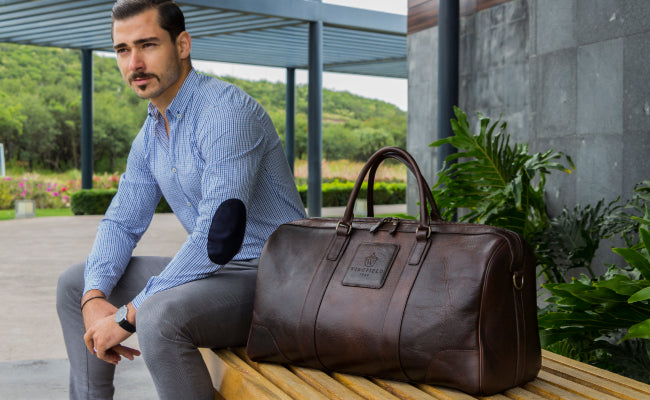
Soft-sided leather has a real advantage here: it compresses in a way that hard-shell luggage cannot. The Dakota Medium Leather Duffel Bag measures 17.5 x 10 x 9.5 inches, which keeps it comfortably inside the carry-on envelope on length and width, with enough give in the leather to settle into a sizer. For a two- or three-day trip, that is the right amount of bag — large enough to be useful, small enough that you are not tempted to overpack.
Five Checks Before You Buy
- Compare against a bag you own. Measure a bag you already like and use those numbers as your baseline.
- Mark it out. Draw the dimensions on paper and hold the outline against yourself in a mirror.
- Read all three numbers. Depth is what separates a bag that holds a day's worth of things from one that only looks like it does.
- Check the opening. A wide opening on a medium bag is more usable than a narrow opening on a large one.
- Account for the leather. Full-grain softens and relaxes with use. A structured bag that feels snug on day one will give slightly over the first months.
Frequently Asked Questions
What is the most versatile leather bag size?
A medium bag roughly 22–30 cm wide with an adjustable strap is the most versatile choice for most people. It holds a full day of essentials — phone, wallet, keys, sunglasses, a compact — without excess weight, and it moves between work, errands, and evenings without looking out of place.
How do I know if a bag will be too big for me?
Compare its width to the width of your torso. If the bag is wider than roughly a third of your shoulder-to-shoulder measurement, it will likely overwhelm your frame. Marking the dimensions on paper and holding them up in a mirror is the fastest way to check before ordering.
Does leather bag size affect how the bag ages?
Indirectly, yes. A bag that is consistently overloaded past its intended capacity will stretch at the seams and stress the hardware. Full-grain leather develops a richer patina with regular, appropriate use — but chronic overpacking accelerates wear at exactly the points you would rather it did not.
Can a leather bag be used as an airline personal item?
Yes, provided it fits within roughly 17–18 x 13–14 x 8 inches and slides under the seat in front of you. Measure the exterior of the bag, including hardware and outside pockets, since that is what airline sizers measure. Soft leather has a small advantage because it compresses under gentle pressure.
The Short Version
Choosing the right leather bag size comes down to three numbers and one habit: the dimensions of what you carry daily, the strap drop that suits your body, and the depth that makes the interior genuinely usable — plus the discipline to buy for your ordinary days rather than your busiest one. Get those right and the bag disappears into your routine, which is exactly what a well-made bag should do.